Friday, 14 January 2011

Dark Star (1974)

In its earliest form Dark Star was a 45 minute long student film by director John Carpenter and writer Dan O’Bannon that enjoyed a relatively successful run around various film festivals in 73.
Having caught the eye of producer Jack H Harris it was transferred to a better quality film stock and extended by a further 38 minutes to bring it up to feature film length.
Although it’s quite a cult film which manages to be amusing while also being something of a pastiche of 2001 and certain elements of Doctor Strangelove, the film its self cost next to nothing with sets and space suits seemingly cobbled together from whatever was to hand.
As well as various household bits and pieces being used to dress the sets, the space suits seen in the film quite notoriously feature Styrofoam packing material doubling as the backpacks with a metal cake tray adding space age detailing to the chest unit.
It’s also been stated that the suits were especially made to resemble the Major Matt Mason action figures so as to allow the once popular toy to be used in the miniature effects shots with only minor customising.
Humble beginnings indeed but it’s still an entertaining film that also managed to launch a couple of successful careers that would go on to make some very substantial genre contributions.

Steve

Ikarie XB-1 (1963)

A Czechoslovakian film in origin, Ikarie XB-1 was made in 1963 but is better known round our way as Voyage to the End of the Universe, the dubbed and edited version released in the states the following year.
It’s the year 2163 and the good ship Ikarie XB-1 is on a mission to Alpha Centauri and the mysterious white planet which orbits it.  Travelling at near-light speed, the 40 strong crew encounter perils ranging from a nuclear armed space wreck that has been drifting since the 20th century, a deadly radioactive dark star (?) and the psychological effects of a 28 month journey upon the crew.
In its original form it’s a film that was way ahead of its time, with a thoughtful script and some very impressive sets.
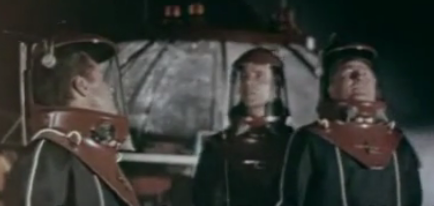
The suit design is also somehow more plausible than a lot of what was hypothesised in other films of this era.  There’s a functionality to them that gives them such practical traits as corrugated joints, armoured chest pieces and magnetisable boots.


Steve

The Andromeda Nebula (1967)

The Andromeda Nebula is a Russian film released in 1967 and based on the novel by Ivan Yefremov.
The film was originally intended to be the first of a sequence with its extended title being; Episode 1. Prisoner of the Iron Star.  Unfortunately nothing came of this greater plan and so it remains a singular tale.
The good crew of the spaceship; Tantra, while exploring uncharted space, are caught in the gravitational pull of an Iron Star (?) and are trapped there for several years.  Slowly the crew are then diminished by alien predators who can consume the flesh of the humans through their space suites.  And what nice space suits they are too.
Steve

Tuesday, 11 January 2011

Spacemen Magazine #2 (1961)

The cover of Spacemen Magazine issue 2 with art by one Bruce Minney, of whome I know nothing.

The spaceman pictured here is sporting a Gemini mission suit, I think, and although they did turn up in movies and TV later on, I would have thought the reference material for this were direct from NASA.

Steve

Saturday, 8 January 2011

First Spaceship on Venus (1962)

First Spaceship on Venus is the dubbed and edited USA release of Der Schweigende Stern (The Silent Star) an East German film based on the Stanislaw Lem’s 1951 novel Astronauci (The Astronauts)
Originaly released in 1960 but set in 1985, the film tells of the discovery of an alien artefact which turns out to be the flight recorder a Venusian spaceship which crashed on Earth some seven decades earlier.
And so with knowledge of their existence confirmed, an expedition is manned and a pleasingly multinational crew is sent toVenus to make first contact.  However, when they arrive they discover that the planets entire population has been wiped out by a nuclear accident.  But even more unfortunately the genocidal machines found in the alien city are still running on automatic and the crew must face many life threatening set pieces before getting to return to earth to warn of the perils of such technology and science.
And that’s it except to say that I’m finding the design of the space suits to be something of a pleasing departure from conventional USA / UK norms of that time.  It might be because they’re new to me but they seem to have an aesthetic to them that goes beyond the functioning practicality of the west’s designs.
 
Steve

Friday, 7 January 2011

Spacemen Magazine #7 (1963)

Issue 7 of Warren's Spacemen Magazine.  This is the second of only two issues published in that year and unusually has a photo cover rather that the prefered fully painted artwork.
The still is clearly from; 12 To the Moon. Which is technically the films second cover and seems a rather lackluster movie to be blessed with such exposure.

Steve

12 To the Moon (1960)

12 astronauts head to the moon where they discover powerful moon-beings who judge humanity unworthy.  They take some captives, exile the rest and then start to freeze the Earth in order to kill off the entire race.  Through displays of love and self sacrifice the astronauts inadvertently make the moon-beings rethink their rash judgement and Earth and humanity are redeemed.....The end.
Sometimes cited as one of the worst films ever made which is probably a bit of an overstatement when in truths it’s just not very good is all.  Slow, cheap and badly acted?  Agreed but with  a crew that’s radically multicultural for the era in which the film was made, you have to admire the intent to show that we might indeed one day all just learn to love each other and get along.  Which is praiseworthy, No?
And while I’m being positive about it,  I think the poster is rather neat.


Steve